
Last updated: November 04, 2026
Key Takeaways
- A solid AI SEO architecture usually includes intake, decision, production, and quality layers tied to one source of truth.
- The intake layer filters topics through the same 6-step process before any model writes.
- The drafting layer works better as separate prompt jobs than as one all-in-one request.
- A page should clear a pre-publish gate for intent, structure, sources, and layout before CMS upload.
AI SEO workflow architecture is the system that turns a messy pile of prompts, drafts, and reports into a repeatable search process that produces usable pages, not just faster content. In this AI SEO workflow architecture — The Complete Guide, it suits in-house teams, agencies, and solo operators who need search output to scale without turning the site into a patchwork of half-optimized pages.
What a good AI SEO architecture actually includes

A good AI SEO architecture includes one intake layer, one decision layer, one production layer, and one quality layer, all tied together by a single source of truth. If one of those layers is missing, the result is usually speed without control: pages get published, but intent matching, internal linking, and revision history fall apart.
Therefore, the simplest useful picture is a four-stage system that moves work from topic to page. At the left end, topics enter. In the middle, the model drafts or classifies. Near the right end, a human checks structure, facts, and brand fit. At the far right, the page ships and is measured against a fixed standard such as Google Search Essentials and basic content QA rules.
Here is the architecture in plain terms:
| Layer | Main job | Typical input | Output | Common failure |
|---|---|---|---|---|
| Intake | Capture the real search task | Query, SERP notes, brand rules | Brief | Vague topic bucket |
| Decision | Choose intent, angle, and format | Brief, audience, competitors | Content plan | Prompt-only planning |
| Production | Create draft sections and assets | Outline, claims, sources | Draft page | Generic prose |
| Quality | Catch errors before publish | Draft, citations, checklist | Approved page | Human rubber stamp |
The key here is the handoff between layers — notice how each one passes a narrower, cleaner object to the next. That is what separates a controlled system from a prompt pile.
A generic article usually gets this wrong by jumping straight from “use AI” to “publish faster.” That skips the part that matters most: architecture is not about writing; it is about routing decisions. If the routing is weak, AI only makes bad decisions faster.
How the intake layer keeps bad pages out of the system
The intake layer keeps bad pages out by forcing every topic through the same 6-step filter before a model writes a sentence. This is where many AI SEO systems fail, because they treat “topic” as the starting point instead of the input that still needs cleaning. If the brief is uncertain, consult a qualified SEO editor or content strategist before production, and use Google Search Essentials as a baseline source for page quality expectations.
Use this sequence:
- Capture the query. Write the exact search phrase, the likely intent, and the page type. Check that the phrase maps to one primary page, not three. Do not turn one query into a catch-all content bucket.
- Record the business goal. Note whether the page should educate, convert, support, or retain. Check that the goal matches the search intent. Do not make a sales page out of an informational query.
- List the audience’s current knowledge. Classify the reader as beginner, intermediate, or advanced. Check that the page will not explain basics to experts or skip the basics for beginners. Do not assume the model knows the reader’s level.
- Collect the source set. Add product docs, policy pages, standards, or expert references. Check that at least one authoritative source exists for factual claims. Do not leave the model to invent supporting material.
- Set exclusions. Write what the page will not cover, such as pricing, local intent, or implementation code. Check that excluded topics are kept out of the outline. Do not let the model widen the scope on its own.
- Assign ownership. Name who approves the brief, who drafts, and who signs off. Check that each role has one clear task. Do not rely on “someone will review it later.”
Because the intake layer is working, the brief should have narrow edges. The wrong version looks like a long paragraph full of “should probably cover” notes. The correct version looks more like a production ticket: query, intent, audience, sources, exclusions, owner.
For a practical standard, keep intake briefs to one page or less. Once the brief spills into a second page, the team usually hasn’t decided what the page is for.
How the AI drafting layer should be structured, not improvised
The drafting layer should be structured as discrete prompt jobs, not one giant request that asks for research, outline, draft, and polish at once. Large language models perform better when the job is broken into smaller passes, each with a narrow output and a visible check.
A clean drafting sequence looks like this:
- Generate the outline first. Ask for section names, not prose. Check that every heading answers a distinct sub-question. Do not ask for the full article before the structure is settled.
- Produce one section at a time. Draft each section against the outline. Check that the section stays inside its job. Do not let the model “flow” into the next section.
- Extract claims separately. Pull out factual statements, definitions, and comparisons into a claim list. Check that each claim has a source or is clearly framed as a judgment. Do not leave facts embedded in prose where they are hard to audit.
- Create examples last. Ask for examples only after the core explanation exists. Check that examples illustrate the point instead of replacing it. Do not use examples to hide weak reasoning.
- Run a style pass. Convert long, abstract lines into plain language. Check sentence length, repetition, and brand tone. Do not let polishing erase meaning.
- Freeze the version. Save the outline, prompt, and draft together. Check that the page can be rebuilt later. Do not work from memory alone.
A key detail is the separation of jobs. The model should not be both strategist and drafter in the same pass, because that is where generic output creeps in. The wrong draft reads like a summary of SEO advice. The right draft reads like a set of instructions tied to a real page type.
This is also where tool choice matters. A general-purpose chat model can draft sections, but it does not replace an editor, a CMS, or a source manager. If the architecture depends on one prompt to do everything, the system is fragile by design.
What should happen before a page is allowed to publish?
A page should pass a pre-publish gate that checks intent, structure, source quality, and layout before it reaches the CMS. This gate matters because most AI errors are not dramatic; they are ordinary, repeated, and easy to miss if the review is casual.
Use this checklist before any publish action:
- Check intent match. Compare the page against the original query. Check that the title, headings, and first paragraph all point to the same task. Do not publish if the page starts with a different question than the one the user asked.
- Check section logic. Read each heading and ask whether it adds something new. Check that no section merely repeats the one above it. Do not keep filler sections that only restate the thesis.
- Check source traceability. Verify every hard fact against a named source. Check that URLs, standards, and product names are real and current. Do not publish invented claims or vague “industry best practice” language with no basis.
- Check internal consistency. Make sure the same term is used for the same thing throughout. Check that “workflow,” “process,” and “system” are not being swapped carelessly. Do not let synonyms blur a defined concept.
- Check page mechanics. Review title length, heading hierarchy, image alt text, and schema if used. Check that the page can be rendered cleanly in the CMS. Do not leave structural cleanup for later.
- Check legal and brand constraints. Confirm that regulated claims, trademark references, and tone rules are respected. Check that the content fits the organization’s standards. Do not assume the model knows legal boundaries.
The visual cue here is a red-line review, not a “looks fine” skim. The right page has visible marks: source notes in the margin, clear heading levels, and a short list of edits. The wrong page gets approved because it reads smoothly, not because it is correct.
A useful standard is this: if a reviewer cannot explain why the page is safe to publish in under 2 minutes, the gate is too loose.
Which tools belong in the stack, and which ones do not?
The right AI SEO stack includes a model, a content repository, a review layer, and a publishing destination; the wrong stack adds extra tools that do not reduce risk or effort. A tool is useful only if it removes a specific handoff problem.
| Tool type | What it should do | Good fit | Bad fit |
|---|---|---|---|
| LLM | Draft, classify, rephrase | Section drafting, brief expansion | Final authority on facts |
| Spreadsheet or database | Track briefs and status | Content inventory, claims list | Long-form drafting |
| Doc editor | Human review and markup | Commenting, redlining | Sole source of record |
| CMS | Publish and structure pages | Title, metadata, templates | Ad hoc drafting space |
| Knowledge base | Store standards and sources | Brand rules, approved claims | Unreviewed source dump |
The key here is the repository layer — notice how it gives the model and the editor the same reference point. That is what separates scalable content operations from one-off prompt sessions.
A common mistake is buying a tool for “AI SEO” before the team has defined the workflow. That usually creates shadow work: copy the brief into one app, copy the draft into another, copy the edits back again. The software looks modern, but the process is slower.
For many teams, the best stack is boring and deliberate. A model, a shared brief template, a document editor, and a CMS cover a lot of ground. Fancy orchestration software only pays off when the team produces enough pages that manual handoffs are the real bottleneck.
Who this is not for: a site that publishes only a few pages a month and has no repeatable content process. In that case, the architecture can be simple and manual. A heavy system will cost more attention than it saves.
How do you measure whether the architecture is working?
You measure whether the architecture is working by tracking process quality before traffic numbers move, then using search performance as the later check. If the process is sound, the content pipeline should become more predictable even before rankings improve.
Use these measures:
| Measure | What it tells you | Good sign | Bad sign |
|---|---|---|---|
| Brief completeness | Intake quality | Few missing fields | Frequent clarifications |
| First-draft edit load | Draft usefulness | Limited structural rewrites | Heavy rewrites every time |
| Source coverage | Fact discipline | Claims map to sources | Unsupported statements |
| Review turnaround | Operational speed | Stable approval cycle | Pages stall in review |
| Revisions per page | Clarity of system | Fewer repeated fixes | Same errors recur |
The key here is the edit load — notice how it reveals whether the model is actually helping or merely producing more text. That is what separates a productive system from a noisy one.
Search metrics still matter, but they are lagging indicators. Rankings can move for reasons unrelated to the workflow itself: seasonality, competitor changes, or technical site issues. So the better test is operational first, SEO second. If a page needs fewer structural corrections, cleaner citations, and less rework, the architecture is improving.
A useful threshold is consistency, not perfection. If the team can produce ten pages in a row with the same brief shape and review standard, the system is becoming reliable. If each page needs a different process, there is no architecture yet — only improvisation.
For external guidance on page quality and search guidance, two useful references are Google Search Essentials and the Content Guidelines from the Chartered Institute of Editing and Proofreading. Both are worth reading as standards sources, not as style inspiration.
What breaks first when AI SEO architecture is careless?
Careless AI SEO architecture breaks the edges first: intent drift, duplicated sections, vague sourcing, and approval bottlenecks. These failures appear before traffic loss because they start at the content layer, where quality problems compound quietly.
The most common failure pattern is easy to spot visually. A page opens with a broad paragraph, the headings sound similar to one another, and the final section repeats the introduction with different words. That is not architecture; that is filler in a smarter wrapper.
Use this 6-point audit on any weak system:
- Look for topic sprawl. Check whether the page tries to answer three intents at once. Do not let one query become a mixed-format article, tutorial, and sales pitch.
- Look for prompt dependency. Check whether the page can be regenerated only by one person with one exact prompt. Do not build a process that lives in a single employee’s memory.
- Look for source debt. Check whether citations are added after writing instead of during planning. Do not treat source checking as a polish step. If the topic affects regulated or high-stakes decisions, consult a qualified professional and verify against an authoritative source before publish.
- Look for review fatigue. Check whether editors are skipping checks because the drafts are too long or too generic. Do not assume more content equals more authority.
- Look for template collapse. Check whether every page ends up with the same structure, regardless of query. Do not force one skeleton onto every intent.
- Look for unpublished corrections. Check whether recurring errors are fixed in the workflow or only in the current page. Do not accept one-off cleanup as system improvement. If the fix could affect compliance, consult a qualified professional before changing the process.
The right correction is structural. If pages are drifting, fix the brief. If sources are weak, fix the repository. If review is slow, fix the gate. The wrong correction is to ask the model to “be better” without changing the process around it.
This is the clearest trade-off against traditional human-only SEO operations: AI can reduce drafting time, but it also increases the need for process discipline. Without that discipline, it multiplies inconsistency. With it, it can make the content team more predictable.
How should a team build this from scratch without overengineering it?
A team should build this from scratch with one content type, one brief template, one review checklist, and one publishing path. Start small enough that every step is visible, then expand only after the handoffs stop breaking.
Follow this 7-step build plan:
- Choose one page type. Pick a blog post, landing page, or help article. Check that the format has a clear success signal. Do not begin with multiple content types.
- Write one brief template. Include query, intent, audience, source list, exclusions, and owner. Check that each field is mandatory. Do not allow free-form briefs to replace structure.
- Define one drafting prompt set. Separate outline, draft, and revision prompts. Check that each prompt has one job. Do not bundle all work into one monster prompt.
- Set one quality checklist. Include structure, source quality, term consistency, and brand tone. Check that every reviewer uses the same list. Do not let each editor invent a personal standard.
- Pick one publishing lane. Move content through one CMS path and one approval path. Check that status changes are visible. Do not route some pages through email and others through chat.
- Run a small batch. Produce 3 to 5 pages in the same format. Check where the process slows down or breaks. Do not scale before the first batch reveals the weak link.
- Revise the system, not only the page. Update the brief, prompt, or checklist when an error repeats. Check that the fix prevents the next occurrence. If the change affects legal, medical, financial, or regulated claims, consult a qualified professional before rollout. Do not patch the symptom and leave the cause untouched.
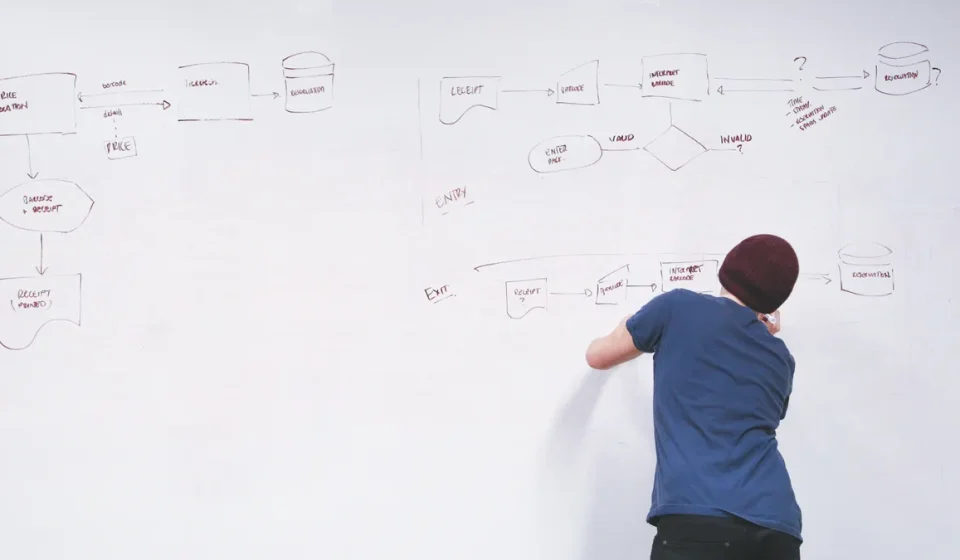
The visual sign of maturity is a small, readable system that a new editor can understand in one sitting. A process diagram on a wall can do more for quality than a stack of disconnected AI tools.
The honest trade-off is speed versus setup cost. A simple architecture takes time to define upfront, but it saves far more time later than a hurried setup that needs constant manual rescue. That is why this approach suits teams with recurring content needs, and why it is overkill for one-off publishing.
What the finished AI SEO workflow architecture should look like in practice
The finished system should look boring in the best way: a clear intake form, a narrow drafting sequence, a visible review gate, and a repeatable publish path. If a team can describe the full path from query to live page in under a minute, the architecture is probably working.
The final page should also look disciplined. The opening should answer the query directly. Headings should carry distinct jobs. Facts should have a home in the brief or source list. Edits should be easy to trace. None of that feels flashy, but it is what makes the system sustainable.
One practical standard helps here: the content should be understandable by a new teammate without a verbal tour from the person who built it. If the process can only be operated by the original designer, it is not architecture yet. It is a habit.
The people who should avoid a heavy setup are those publishing rarely, those with no editorial review, and those chasing automation because they dislike process. AI does not remove the need for judgment. It makes judgment more visible.
The real goal is not to produce more pages. It is to produce pages that can be planned, checked, and improved without guesswork. That is the difference between AI as a shortcut and AI as a system.
FAQ
Is AI SEO workflow architecture only for large teams?
No, it works for small teams too, but the setup should be lighter. A solo editor can use the same logic with a one-page brief, a short checklist, and one drafting model. The difference is scale, not principle. Complex orchestration only makes sense when many pages move through the same path.
What is the biggest mistake people make with AI in SEO?
The biggest mistake is asking the model to do strategy, drafting, fact-checking, and editing in one pass. That creates generic content and hides errors. A better system separates those jobs so each one can be checked on its own, especially when the page carries factual claims or brand-sensitive language.
Do I need special software to build this?
No, special software is optional. A document editor, a spreadsheet or database, a model, and a CMS are enough for many teams. The architecture matters more than the tool count. If the process is clear, simple software will do the job. If the process is unclear, expensive software will not fix it.
Drafted with AI; not yet reviewed by a person.